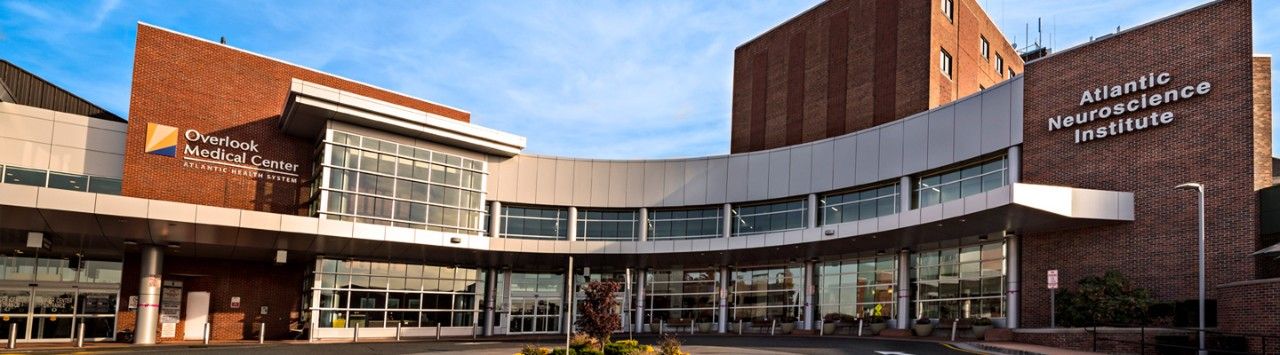
About Our Hospital
Overlook Medical Center was named one of America's 50 Best Hospitals in 2024 by Healthgrades, a 2024 World’s Best Hospital by Newsweek and recognized as a Best Regional Hospital in the NY Metro area by U.S. News & World Report for the 13th consecutive year.
Our Atlantic Neuroscience Institute is the region’s leader in neuroscience care. A hub for the New Jersey Stroke Network, we offer a broad range of advanced neurological, neurosurgical and neurodiagnostic services. We are also certified as a Level IV Epilepsy Center and home to the Gerald J. Glasser Brain Tumor Center, where more brain tumor surgeries are performed than anywhere else in New Jersey. Our CyberKnife® program is the largest and most experienced in the state.
What’s more, we are recognized as high-performing for heart attack and heart failure by U.S. News and World Report.
We provide advanced cardiac imaging, cardiac catheterization, elective PCI and minimally invasive procedures. Furthermore, Overlook is among a select group of hospitals licensed for primary angioplasty.
Committed to providing exceptional care, Overlook Medical Center has achieved the prestigious Magnet® recognition. This designation from the American Nurses Credentialing Center is the highest national honor for nursing excellence. What’s more, Overlook Medical Center has advanced certification from The Joint Commission for perinatal care and is designated an Advanced Comprehensive Stroke Center. Additional Joint Commission-certified services include behavioral health care, spine surgery, wound care, and primary care medical home (PCMH). We also have a satellite emergency department in Union, NJ, which treats about 40,000 emergency cases each year.
Featured Services and Specialties
Welcome to the World, Baby!
An Inside Look at Overlook Medical Center's Maternity Center

Overlook Medical Center's Maternity Services and Amenities
Maps & Directions
Plan your visit to Overlook Medical Center today. Find driving directions, special car services and public transportation routes.
Parking & Accommodations
Overlook Medical Center offers several parking options, so that all of our patients and visitors have easy access to our hospital. Special housing accommodations may be available for relatives and extended family.
Awards & Designations




99 Beauvoir Avenue
Summit, NJ 07901
908-522-2000